

Jo Macsween, Leadership coach and Vistage group chair
(July 2020)
“The mythology of the leader is changing. It’s OK to say, ‘I don’t know’. It doesn’t mean, ‘I’m stupid’. It means, ‘I’m open; I haven’t formed an opinion yet’. That willingness to be vulnerable needs courage.”

MUM AND STRATEGIC VISIONARY
Jo Macsween is a leadership coach in Scotland with Vistage. But her name is synonymous with Macsween Haggis and her role in making it a household name and an international success story.
For those of you unfamiliar with Scotland’s delicious national dish of minced lamb offal, oats and spices, haggis became famous thanks to Scottish poet Robert Burns’ Address to a Haggis. (This is one of the more entertaining recitations, which is the centrepiece of any self-respecting Burns Night celebration.)
Burns Suppers are known for their whisky-fuelled toasts and (still too commonly) men-only gatherings. Yet the success of the world’s most famous haggis brand is in large part down to the women in the family.
Jo’s dad, John, took over the business from his father. At the time, it was a local butcher’s shop in the posh Morningside district of Edinburgh. Jo recalls how much John loved running the shop and looking after the Morningside ladies. But it emerges just how influential Jo’s mum Kate was in strategic decisions for Macsween. Jo recounts this one pivotal moment:
“Dad would have happily stayed in retailing – he loved the shop and resented the EU regulations that were coming in during the 1980s.
“But mum saw the regulations as an opportunity at a time when supermarkets were eating away at our retail business.
“She eventually persuaded dad to stop competing with Tesco, and instead supply them. So, we closed the shop in Morningside and moved to an industrial kitchen outside Edinburgh.”
This was a huge turning point for Macsween. And it was Jo’s mum driving that strategic decision. The family business dynamic – in which Jo’s mum had the vision, and Jo’s dad had the open-mindedness to Kate’s idea – must have been inspirational to the young Jo.
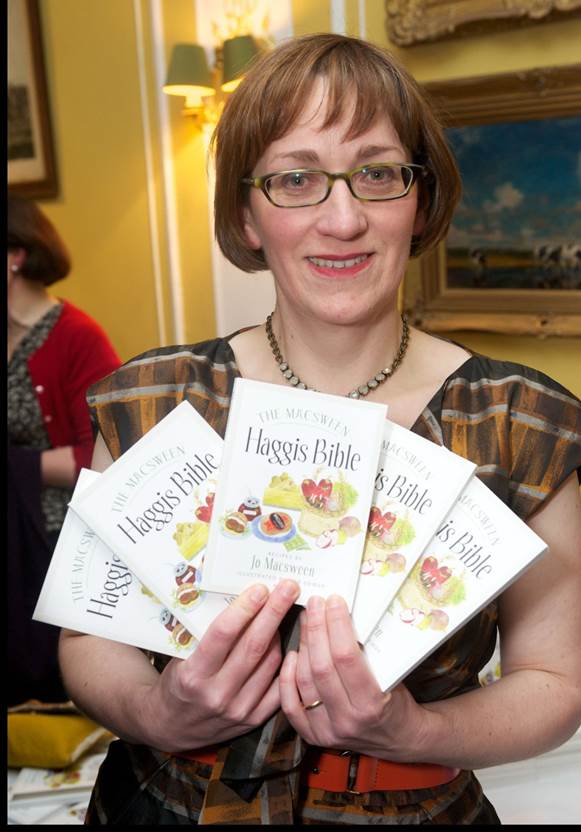
Jo joined the business in 1992 to work alongside her mum, dad and brother James. But it was 2006, after John died, when she became joint Managing Director alongside James. Macsween went on to grow annual revenue from £1 million to more than £6 million under her tenure, and became a Scottish success story and internationally renowned brand.
THE PORTRAIT
Jo is incredibly thoughtful, and attends to the tiniest details.
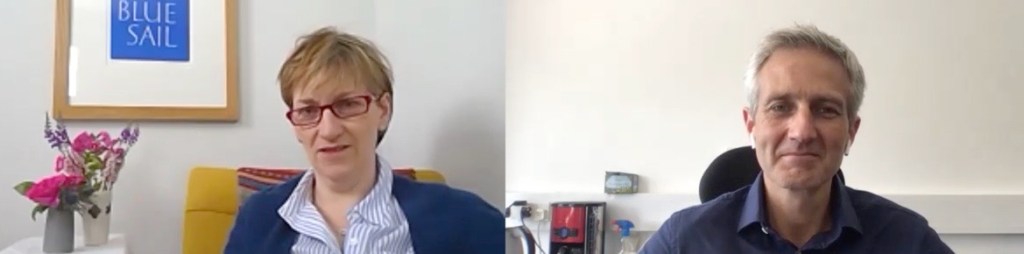
In this Covid world, she started off a Zoom novice and technophobe and became a Zoomophile in the eyes of the Vistage group of business leaders that she coaches.
Jo’s Zoom set up is immaculate. A small side table is covered in a starched, white, linen cloth with two small vases of fresh flowers. The picture behind her is an illustrated lyric by Scottish poet, Ian Hamilton Finlay: “Evening will come; They will sew the blue sail”).
The metaphor is apt. “Sewing the blue sail” alludes to a sea farer repairing a frayed or broken sail at the end of the day. Is that how Jo sees her role as a coach: helping business leaders to mend their fraying edges, ready to sail once more into the waves? If so, then Jo sets about her mission with a calmness that’s uncommon in Scottish coastal waters. She has an empathy that’s immediately disarming for any egotistical MD that seeks to impress with (usually) ‘his’ blustering rosy-cheeked résumé. Unsurprisingly, Jo’s leadership group is absent of such caricatures. That speaks to Jo’s vision for her group, which we named Venturesome. We are daring and adventurous and spirited, and Jo fosters that spirit with us collectively and individually.
NO-ONE LEAVES A FAMILY BUSINESS
Jo has always been one to follow her own recipe for life and decision making. She projects a quiet confidence of someone who’s used to treading her own path.
Jo didn’t initially relate well to formal learning at school and described herself as a bit of a day dreamer, but she cultivated the undervalued skill of getting on with people. She travelled through Europe alone, teaching English in eastern Europe. And even when she decided to join the family business, Jo insisted on going to get the qualifications she needed to get the job on her own merits.
Referring to her role as joint MD with James, Jo insists that it worked well – again defying traditional business thinking. Though there were pros and cons, they mostly agreed on the values and strategy, and then divided responsibilities around their natural skillsets.
Ultimately, Jo broke the biggest convention of all: she left the family business. Jo explains:
“I took over as MD when my dad died. I recall very clearly that morning. It felt like a spiritual experience – a deep ancestral connection – and I started to question my own mortality for the first time in my life.
“Shortly after, at a family retreat, I flagged to James and mum that ‘one day, I might not want to be in the family business’. By externalising that, something shifted, and it became an active question in my mind that I needed to work through.
“That’s when I looked for some stimulus from outside the family, ideally a peer group to challenge me, and I found it in Vistage. I wanted to achieve three things: grow myself as a person; grow the business; and resolve my ‘exit’ question. My Vistage peer group helped me to accomplish all three.”
When we start to discuss succession planning in a family business, Jo sits forward and is passionate about her experience – and that of other family businesses she works with.
“How early should you start to plan a succession? At least 10 years. But most don’t, and it usually takes a crisis to make the change. People generally only get on with succession work in a family business for two reasons – death or illness.
“For a family business to thrive through a succession process, the next generation needs to be trained up, and have the proper authority in place. And the exiting generation needs to have a satisfying thing to go on to, so they don’t feel inclined to step back in and undermine the new team.
“In the late 90s, when we were preparing for James and me to take over from dad, we joined a peer group for family businesses, learning from them the best and worst things to do. We hired a facilitator. We went on retreats. And we held endless conversations.”
In the end, the transition was a success. And Macsween thrived as Jo and James took over.
The complex dynamics of a family business, Jo feels, make it even more important to handle succession sensitively and early. But I wonder if the same principles should really apply to any business that wants to ensure an orderly transition.
JO’S THREE SECRETS TO BETTER LEADERSHIP
Jo left the family business without a plan for what came next. That was deliberate. And uncomfortable. She admits it was hideous for a while, but then she started to enjoy it.
To help her work out what would come next, Jo listed out the things she loved doing and things she didn’t enjoy. At the top of the list was coaching. And so, Jo embarked on her second career by training as an executive coach.
Jo has been chairing a Vistage group of 12 CEOs and founders in Scotland for three years. Having viewed leadership through the lens of a family-business managing director, as a member of a Vistage executive peer group, and now as the chair of her own Vistage group, she’s noticed some clear changes in leadership.
“The mythology of the leader is changing.
“No longer is it that the leader is under pressure to ‘know all, tell all and be all’. In my group, when people have the courage to be vulnerable and speak their truth, they become better leaders. If anything, I am often struck by the transformations in the male leaders I work with. They benefit immensely from the safe space their peer group gives them.”
Jo also reflects on the other skills she sees as being critical to becoming a better leader.
“It helps to be numerate. But when I think about my own skillset and the CEOs and founders I’ve come across, I’ve found that creativity and people skills trump the lot.
“Put those together with a dose of vulnerability – that willingness to admit you don’t have all the answers – and you’ve got a powerful combination of leadership skills.”

FOLLOWING IN MUM’S FOOTSTEPS
Jo’s passionate about great leadership. She believes it should be more diverse and, with her name and story, feels a sense of responsibility to the next generation of female leaders. So she’s become an Ambassador for Women’s Enterprise Scotland, using private mentoring and public speaking to enable more women to achieve their dreams of entrepreneurship.
“Only one in five small businesses in Scotland are run by women But these businesses contribute £8.8 billion to the Scottish economy each year. They are growing at a faster rate than male-run businesses, but it remains an uneven playing field.
“Worse still, only £1 in every £100 of venture (VC) capital funding goes to women-run businesses. It’s clear that women’s ideas don’t fit with what the average VC investor thinks is investable.”
Jo also challenges men on their role in workplace diversity.
“You can’t be what you can’t see,” she says. “Men have a role to play too. As the incumbents, guys have a responsibility both to promote the inequality issue and also to address it in their boardrooms.”
Jo’s passion is far from male-bashing. As a long-time member of her Vistage group, I see first-hand the fairness and equity she brings to the men and women among us. Indeed, her dad’s version of feminism and her mum’s role in the success of Macsween has clearly shaped Jo’s thinking in a balanced way.
It’s this combination that has enabled Jo to be incredibly successful in her family business and a tremendous coach in her second career. Jo’s designed a fresh recipe for leadership that is helping Scottish CEOs and founders become the best versions of themselves. To that, I raise a glass.
This interview was conducted on 6 July 2020
 theleadstory.co