
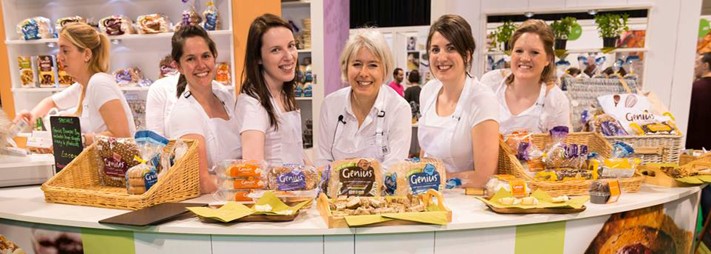
Lucinda Bruce-Gardyne, Founder of Genius Foods
(September 2020)
“I always wanted to help people in some way to do with their health, and through food. So somehow the stars aligned.”
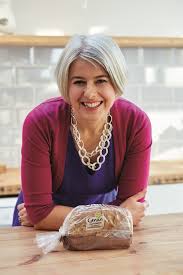
A MOTHER’S PAIN
Imagine your son or daughter comes home from school and tells you they’ve not been invited to their friend’s birthday party. They try not to let it show, but you know they’re hurt. You try and comfort them, but they know you’re hurt too.
Then you discover why your child’s been excluded. You expect it to be because of a disagreement in the playground. But, no. The other parent is scared of what to feed your gluten-intolerant child.
That might seem ridiculous today, with the amazing choice of gluten-free food on offer. But back in the early 2000s, that was exactly the challenge facing mother of three boys, Lucinda Bruce-Gardyne. Lucinda picks up the story of how she came to set up Genius.
“I read physiology at university so I’m a scientist at heart. But I’m also a foodie: after graduating, I carried on studying at Leiths School of Food and Wine and London restaurant Bibendum. I went back to Leiths, where I wrote the Techniques Bible, about the science and functionality of food and ingredients. And then, I researched and wrote How to Cook for Food Allergies.
“Around this time, I had my first two boys. My eldest is severely allergic to dairy. My second was diagnosed with the gluten intolerance that was so misunderstood 20 years ago.”
While Lucinda was writing The Leiths Techniques Bible, she spotted a howling gap in the market: gluten-free bread was terrible. And given that one in 100 people in the UK live with coeliac disease, that was an incredible opportunity for someone with Lucinda’s unique skills and experience – not to mention her son’s health needs.
“The birthday party incident was probably the trigger that motivated me. And with my unique background, I felt I had a good chance of finding a solution. I always wanted to help people in some way to do with their health, and through food. So somehow the stars aligned.”

PORTRAIT OF LUCINDA
Lucinda is sat at her kitchen table in Edinburgh, right in the spot where she developed those first loaves that transformed the gluten free bread market. In fact, as we talk on our Covid-enforced Zoom call, she goes to check on some dough that is proving. It’s a treat for me to see in action the never-ending search for the perfect gluten-free loaf.
This is our first conversation, yet Lucinda is relaxed, smiling and understated. She mentions in passing that she comes from an entrepreneurial family, which gave her another reason to start up Genius. She’s not kidding: Lucinda’s ancestors founded the J. Lyons food empire, famous for some of my own childhood favourites like Bakewell Tart, French Fancies, and Battenberg. Baking is in her DNA.
A MOTHER’S PRIDE
Back in the 2000s, Lucinda turned her kitchen into a chemistry lab, as she took a very scientific approach to developing a tasty gluten free loaf. And because children don’t lie, they were her chief tasters. Three years and two ovens later, the boys gave her the thumbs up and the first Genius gluten-free bread was launched in 2009.
“I made thousands of loaves. The kids would get back from school; there’d be 14 loaves of bread on the side by the time they got home. Most of them looked dreadful, like little bricks. Gradually they got taller and taller, and fluffier and fluffier.
“Then, one day, they said, ‘wow, that tastes delicious’. Once they liked it, I got in touch with my local Sainsbury’s and asked if they knew of a gluten-free bakery. They put me in touch with a bakery in Bathgate, and they offered to help me scale it up, because they’d never seen a risen, fluffy, soft loaf before. We now own that bakery.”
Genius was a product development and marketing company at the time. The bakery grew its business very quickly on the back of Lucinda’s intellectual property and had become very powerful. Because Lucinda’s IP was so accessible to the bakery, this was a risk to the business. So she had to make a big decision to protect the brand.
Lucinda decided that the only way to protect their IP was to buy the bakery. So, they bought it for £21 million in 2013. The fact she was able to raise the cash underlined the scale of the opportunity in this new gluten-free category.
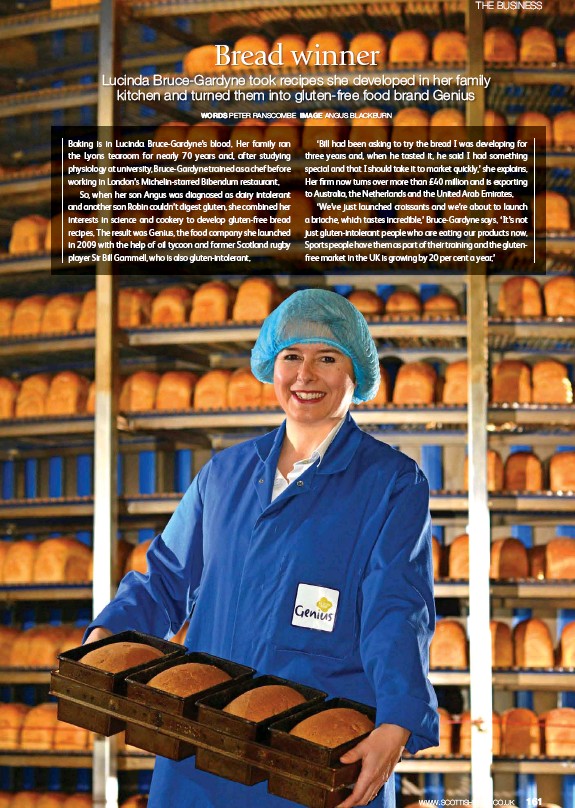
So in February 2013, Lucinda became the proud owner of a bakery in Bathgate and a sister bakery in Hull. Overnight, Genius went from a team of 20 food scientists and marketers to running an organisation of more than 600 people.
THE CHALLENGE OF COMMUNICATION IN A TAKEOVER
Most people working in the bakery want to come to work, make great bread, service 100% of retail orders and go home again. Gluten-free production, however, isn’t for the faint-hearted. In the past, the manufacturing process has been challenging to perfect and would quite often fall over. That’s demotivating for the workforce and unpredictable for customers.
The key to better customer service and a calmer workforce was using a blend of science and artisanal methodology to design an efficient process that is almost pharmaceutical in nature. And Lucinda and the team achieved that. Genius has reduced wastage down from an average of 10% to below 4%, and continues to make further efficiency improvements which makes meeting orders each day much more achievable. Because of that, it’s given the team a real morale boost and renewed pride in the brand and in delivering great customer service.
But it’s been far from plain sailing. Going from 20 to 600 people involved buying a factory with a culture of anger and resentment. Turning that around and creating a new culture and positive communication was the ultimate challenge.
“I thought we were good communicators. But when we took on the larger workforce, our message around the changes we were making just didn’t filter down to the factory floor. That led to confusion and frustration – and all because we weren’t communicating in the most effective way.
“But we noticed it quickly and changed our approach. Now, we’ve got a system that works much better. We started to run quarterly staff surveys and morning meetings when the teams would all get together. And we began an employee forum, in which everyone’s voice is heard. I’m not saying we get it right all the time, but people feel much more listened to than before.”

MODEL FOR BUILDING A PORTFOLIO CAREER
Genius grew fast and Lucinda has elevated herself by bringing in a management team to support the business’s growth. This has allowed her the time to curate a portfolio of appointments that play to her strengths but also her passions. It’s a fantastic example of a career that both motivates a person and also brings value to a wide range of organisations.
Lucinda now works with Genius three days a week. That’s allowed her to become involved in other work. She’s an Entrepreneur in Residence at the Physics School in Edinburgh University, funded by the Royal Society. And she sits on boards of the ScaleUp Institute in London, Scotland Food & Drink and The Society of Chemical Industry for whom she gave this recent interview ahead of judging The BrightScidea Challenge.
“I think these roles complement my work at Genius. Working with the physics department at Edinburgh University allows me to give something back to the department that helped me understand the bubble structure of our bread.
“I strongly believe in the importance of the scale-up sector to the economy. I think we contribute something like £3 trillion to the UK economy each year, and scale ups are very resilient, so they are a big part of keeping us going through the Covid pandemic.
“And as for Scotland Food & Drink, our country has so much potential. We’re not doing anywhere near enough around food tourism. And there’s lot we can do to improve the nation’s health by better education around food and cooking.
“I love the board positions I work on: they allow me to give something back to the parts of the economy that I’m most passionate about.”

A FINAL TIP – STAY HUMBLE
As a sole founder of a hugely successful company, Lucinda is often asked to give advice to the next generation of business leaders. Her interview with Entrepreneurial Scotland is two minutes well spent for any budding entrepreneur: she gives three tips: be open to exporting, focus on customer satisfaction, and keep control of your ego.
Lucinda speaks with passion about the last of these.
“If you’re in an executive position, it’s very easy to be separate from the rest of the organisation and believe your view is more important than others’.
“I think a really great executive is in tune with everyone’s voice, and you can only be that person if you’re not full of your own ego. That’s something I’ve found important by observing and learning along the way.
“Don’t fall into the trap you’re something special. You happen to have started something. You got lucky enough to have a real mission in life and the opportunity to play that mission out. But it doesn’t mean you’re better than anyone else. So as a founder, it’s fundamental to stay humble.”
It’s obvious Lucinda lives by that mantra, despite having built a hugely successful £35 million (and growing) business, changing hundreds of thousands of gluten-intolerant sufferers lives with a fantastic range of category-killing products.
While Lucinda may not be outwardly proud of her achievements, your fellow Scots are, Lucinda. Pure Genius!
This interview was conducted on 16 September 2020
 theleadstory.co